Showing posts with label india. Show all posts
Friday, November 29, 2013 0 reflections

Rediscovering Ramanujan


To say that Robert Kanigal's book “The Man Who Knew Infinity” is about the life and times of Indian Mathematician extraordinaire Srinivasa Ramanujan is actually a huge disservice not just to the author but also to the muse. Packed in the pages of this book is so much information on the times that prevailed before and after Ramanujan that the author needs to take a bow for the colossal amount of research he has conducted on every critical aspect of the man's life. Be it examining G.H.Hardy's life before he heard of Ramanujan, or be it the vessel S.S.Nevasa that took Ramanujan from India to England – the book is a treasure trove of information for anyone wanting to genuinely want to know more about the man behind the genius. In writing this bird's eye review of the book I find myself debating what to add and what not to given that almost every page of this fantastic biography is peppered with thousands of little details that go beyond the names of Ramanujan and Hardy.

But first things first – what this book does quite well is demystifies the man we in India (and abroad) have to come know only from the tilted face view of his photograph. As it turns out that photograph was taken during the worse times of his life in England as he prepared to make his journey back home after several months of ill health. Known to be a rather portly fellow Ramanujan fell victim to a bizarre case of TB from which he never fully recovered. Other photographs of him during his early days in England perhaps do more justice to the generous extremities he was actually known for. It is said he looked like a male version of his mother and that is quite a good way to put it.

But his journey into England and then his return to India to draw his final breathe is really the tip of the iceberg. There is so much more that I did not know about this man before reading this book. Like, for instance, the ineffective and almost merciless education system prevalent during those days which disallowed him from having a proper education given his natural affections only towards Mathematics. Or the extremely absurd yet rigid in its roots – the Tripos Mathematics examination – that every Cambridge scholar hoping to become a Wrangler had to take. Or the dozens of people – Indian and British alike – who moved heaven and earth to bypass regulations and rewrote rules to get Ramanujan to Cambridge, to Trinity. Hardy, obviously, played a big role in being the one person who came closest to perhaps knowing what Ramanujan was about (and there is abundant evidence in the book for the contrary) but so were people like EH Neville, a lecturer in Madras, Hanumantha Rao (a math professor at an engineering college), Narayan Iyer (Ramanujan's colleague) and many more such intellectuals who came together to find a way to prove to the West, and to the world really, that Ramanujan was no crank and his theories were no “products of a fake genius” but a talent so rare and powerful that it had to be nurtured, cared for and if at all possible, amplified for generations to come.

The book looks at Kumbakonam of that time (which surprisingly – and refreshingly – even after a century has still retained a lot of its old world charm) which became home for a young Ramanujan. We get to meet his formidable mother, a rather prominent force in his life, Komalatammal – a woman of a strong personality bordering on the irrational. We get to look at young Janaki's life who married Ramanujan at the tender age of thirteen but it would take her six more years to really get to know her husband who spent most of his remaining life in absentia. Her becoming a widow at the young age of twenty and then her struggle for survival in a society that had no mercy for widows makes for a compelling read. We also get a close up look at Hardy who steps out of the one dimensional image of being “that Brit with whom Ramanujan collaborated” and gets a background, a human face and soul and is layered with various levels of style, charisma, precision and elegance both as a mathematician and as an Englishman. A man who was forced to come out of his social shell to accommodate the rare talent in Ramanujan. As the author at one point states - “Hardy did not discover Ramanujan. It was Ramanujan who had discovered Hardy.” This rings true throughout their journey as two perfect contradictions in every imaginable way brought together for the love of numbers and the beauty of infinity.

The book is also loaded with a lot of interesting mathematics. It occurred to me while reading the book that had I been (and I speak for a lot of my generation) introduced to mathematics in a fun way which made the connections seem logical I would perhaps had a better appreciation (and who knows, even love!) for the subject. But the reason I feel maths is hated around the world as a popular opinion is the bizarre and unnecessarily complicated ways in which it is learnt and taught across the board. The book, through simple examples of theories like continued fractions or mock theta functions or the prime number series captures such fantastic patterns that for a brief fleeting moment I could not help but admire the fun aspect of mathematics.

The book also spends considerable time on the Brahminical roots that Ramanujan was woefully tied to. Given his orthodox ways in the religion and an absolute refusal to adapt to Western diets despite his falling health and consistent appeals from physicians it makes for a frustrating read in some parts as we watch a true gift, a miracle, wither away because of lessons he had picked up as part of his life before England. Much of his belief in God and the infinite nature of the universe stemmed from his love for mathematics. This is perhaps why his famous statement on equations and god's thought is so prominently heralded to this day. For him there was truth in all gods and yet his obstinate attitude towards anything alien, his gradual disconnection from the realms of reality, his slow descent into depression towards his final days in England – all point to a mentally fragile individual who had the nerves for mathematics but little else. His erratic eating habits, lack of exercise, reluctance in being part of a culture that was so different from his own – all add up eventually to bring to him the lethal disease.

The book ends, as expected, with Ramanujan's death at the age of thirty two resembling a “bag of bones” due to his abnormal weight loss. It then goes on to talk about the events that took place after that, leading up to the 1980s when a lot of his theories were found and examined by prominent mathematicians around the world. To this day a lot of his work remains a mystery as more talents try to figure out just how a semi-educated poor Brahmin from an almost nondescript town in Southern India had the vision to formulate such complex equations to begin with. I guess that will forever remain a fascinating story to tell indeed.

After several years of knowing about Ramanujan and having seen only glimpses of his work in passing I am finally happy that through Kanigel's book I finally got a front row seat to not only his life but also those whom he touched and inspired. His collaborations from 1914 until 1920 are perhaps one of the most significant ones in the history of world mathematics. I only hope that more people (and not just Indians – although I do feel this book should be compulsory reading in all Indian schools) get to know the man behind the genius to fully appreciate and acknowledge what a rare talent had been born in what was supposed to be an extremely poor, immensely diseased and unashamedly uneducated part of the world.

I can only hope that India continues to recognize and support millions of Ramanujans who, even as I write this, are struggling to get their ounce of recognition in a society that cares only for the shallow requirements of an equally shallow world outside.


..ShaKri..


Wednesday, July 17, 2013 1 reflections

Krishna Row Agraharam


Historic sign at the entrance
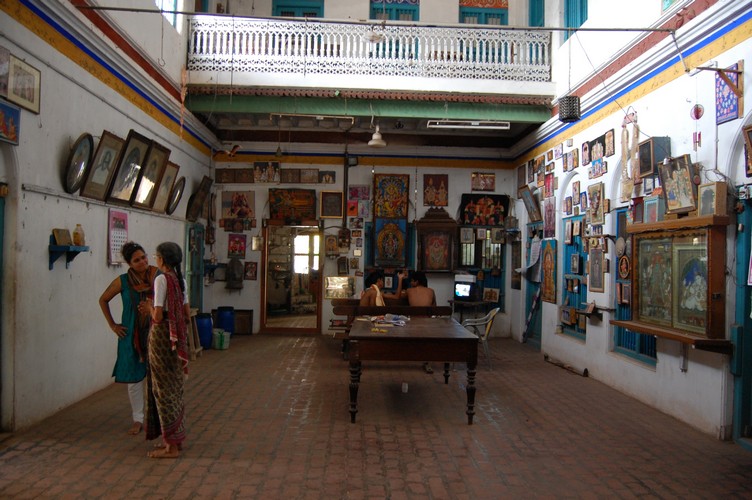
The pillars are quiet now yet leaning against them is like meeting a thousand memories. The floors are now ripe with age yet one can feel the soft rumble of a thousand feet from before. The walls have swallowed sunshine and rain yet seem to be forever smeared with voices from a century ago. A mere stroll through #1 Krishna Rao Agraharam – a palatial mansion in the heart of old Kumbakonam – has the potency of bringing back powerful images from another era. Sitting first in a row of several homes built in a similar style this mansion is the highlight of a larger collection that form the part of the legacy of Mr. Gopal Rao – the current descendant and caretaker of a story that began more than two centuries ago. Looking into this house’s generously laid out living spaces, examining the rusted bars sealed between its pleasant blue window frames, taking in the air that envelopes this fine moment in time revealed several stories that span across so many eventful decades.

Portrait of Ranganatha Rao
But the real story of this place begins elsewhere. In those days a man named Narahari Rao is said to have acquired property amounting to over 6000 acres through means that I am told qualify to fill up several interesting volumes. An employee of the then Nayak kings, Rao was said to have changed allegiance to join the East India Company at Tirucherai, a beautiful village nestled on the banks of Cauvery, once the British began establishing domain in the region. Subsequently around 150 years ago his descendants then shifted base to Kumbakonam which was the cultural and literary hub of the time. It was through this move that the person after whom this cocoon of homes is named – Krishna Rao – ended up being a descendant of this huge family.

Living spaces in the ground floor
Though part of an adopted lineage Krishna Rao managed to acquire several urban properties and one of which became the Agraharam. The word “Rao” was spelt “Row” at the time and this can be seen imprinted firmly at the entrance of the street to this day. The word “Private” in the engraving further solidifies his desire to create this spacious haven for all his kith and kin. After Krishna Rao’s time the house continued onto several hands. Amongst first of those were children of Krishna Rao’s two wives (daughters of Reddy Rao, a former Dewan of Travencore). It was his son Ranganatha Rao who built the home located at # 1 in its current state. A fire incident is said to have destroyed what was formerly a smaller establishment.

Pillars in the main area
Built in the naatukottai style the current version of the house is 90 years old. Attached to this generous edifice are several other homes of which # 4 is used by Mr. Gopal Rao whenever he visits Kumbakonam. Homes that follow the fourth house were given away as gifts to Vedic scholars and other employees of the family. A Vittala temple was also constructed as part of this Agraharam while the entire stretch of area opposite to this street was housed by orchards, stables and flowering gardens. Today unfortunately these spaces have been replaced by less attractive and more intrusive concrete blocks where other folks live.

Living area on entering the house
With passing time Krishna Rao’s legacy began taking various forms. Both of Ranganatha Rao’s sons were childless and so children of his three daughters and their families began living in the homes. At one point, and I was shown a fabulous black and white family photograph as evidence, there were more than 150 people living in this house! Just imagining such a crowd walking in and out of its spaces day in day out made me reflect in wonder at the sheer energy of this corner. Of the collection of homes the first two were a place where everyone
Well ventilated spaces on entrance
lived the most. Armed with an attached kitchen the whole place must have felt like a never ending wedding ceremony with hot meals being dished out each hour of the day! Together with the first floor sections the entire collection of four houses in the Agraharam comprise a whopping 22000 square feet in area!
   
Apart from being one of the largest homes of its time this Agraharam was a pioneer for various things. It was the first residential house to have electricity, running water, a custom built rice hulling mill and a battalion of support staff that included accountants, cart and car drivers, milk men, sweepers, cooks, servers and watchmen. A continuous stream of life forms would enter and exit this activity-heavy entity
Rooms on the first floor
throughout the year. It is said that whenever a celebration of any kind would take place (and you can only imagine the unending crescendo of voices and events at such a time) the entire area including the adjoining streets would be cordoned off to disallow public entry. Rows of cars would be lined up awaiting service at any moment. Adding to this colossal list of amenities was a separate bathing ghat inside the Vittala temple exclusively for the women in the household.

First floor view of the house
As I stood there watching the stories unfold and tales from a bygone era spill forth like velvety dreams my mind filled up with voices and apparitions. I could see men in traditional attire crisscrossing the floor spaces, their faces busy with intent for the day. I could see children wailing on young women’s arms as the elderly ladies sat in corners and dispensed invaluable advice on proper child care. I could smell the heavenly aroma of a dozen dishes emanating from the culinary corners as people – young, old, tall, short, fat, thin, sleepy, awake, known, unknown – sat in dedicated rows indulging in all the delicacies served up on fresh green banana leaves. I smiled at the realization that such a scene perhaps was now a lost glimpse in history’s infinitely growing painting.

The action packed kitchen area
Over the years a trust fund (currently in the name of Satyatma Teertha of Uttaradi Mutt) has been established to help maintain it as best as possible. There are over 30 claimants from the family who sort of own the entire Agraharam. Currently Mrs. Shyamala Rao (Mr. Gopal Rao’s first cousin Ranga Rao’s bereaved septuagenarian wife) lives at the palatial mansion mostly by herself. People who have known the family for literally centuries visit the place often and help out in more ways than one. During our first visit to the house the chronic power blackout that plagues the region had struck. Despite the pitch darkness a certain Geeta aunty – a family friend – prepared a wonderful dinner just for J and I at Mr. Gopal Rao’s request. Watching her serve up that excellent meal with an earnest smile was truly a humbling experience. It helped me learn some more of the cordial relationships that Mr. Gopal Rao has maintained with the families in the neighborhood to this day. Little wonder then that such sincerely helpful people are part of his very diverse network.

Terrace area on the second floor
On our second visit to the Agraharam a larger banquet had been arranged where, due to the water shortage problems at the Vijayendra Swamy mutt nearby, about 30 odd people (mostly strangers) had been invited over for a festive lunch at Mr. Gopal Rao’s residence. We found it fascinating that such a diverse and mutually unknown group was sitting down with us and enjoying the delicious Tanjavur Marathi cuisine coming out of the kitchen. It felt like the ideal way to continue such a beloved family tradition. Some heavenly “emergency halwa” and the quintessential Mandi Sambar Bhath were consumed while observing the dedication that had gone into both preparing and serving up the luncheon.

J spent the next hour and a half of our visit to the palatial house speaking to Mrs. Shyamala Rao. I walked around snapping whatever my limited understanding of such grandeur could surmise. She later told me about the eventful life Mrs. Rao had led in that house since the day she had walked into this gargantuan family as a teenaged bride. Coming from a less traditional background she had spoken of the culture shock she had to put up with in a home that was pretty high on Brahmin orthodoxy. Since it was a time when strict regulations were in place for the women of the house Mrs. Rao had faced an uphill task in getting used to her prescribed chores. Being from a liberal family she had found it challenging to adhere to special feminine restrictions levied upon her during certain times of the month. She, amusingly, shared her grief about having to use a less sophisticated toilet facility which she also admitted had become modernized with time.

View from the first floor
Being a fiercely Brahmin household the concept of soula (“madi” in Kannada and in a lighter tone: also defined as “an exaggerated, sometimes misguided, religious explanation of basic hygiene”) was in full swing. To help maintain this purity of things Mrs. Rao spoke of the different rooms in the Agraharam that had designated functions. One of the rooms in Mr. Gopal Rao’s residence (where I switched over to a traditional South Indian panche/veshtee/waist cloth for the mega festive luncheon) was assigned only for child births. A record number of sixty children are said to have been born there. It was funny, and a little scary, to imagine all the sixty kids wailing in that little room at the same time.

Divine presence on the walls
There remains a strong presence of divine adherence in the family. Hence, the Agraharam has played host to many a swamiji from various Brahmin sects when they spent several days performing prayers and blessing the household. Grainy photographs exist of their attendance to this day acting as a friendly reminder of better days. The pooja room on the ground floor and the large main living area’s walls are sprayed with dozens of photographs of various Hindu gods. I even spotted a couple of authentic Tanjavur paintings in that collection – a family heirloom of sorts – which have been preserved quite well.

Row of rooms on the first floor
Given such an unending stream of social and religious fares the kitchen was always open. In fact Mrs. Rao told us of a traditional wooden stove that was used exclusively only for the Jahangir sweet! Since that sweetmeat was considered “non-Brahmin” (it was from Persia and hence labeled a foreign entity) a special stove was dedicated only to it. The idea of designing something so exclusive to indulge in it whilst maintaining disdain for its origins made us all laugh with empathy at the familiarity of it all. The entire area around the kitchen was used to store large quantities of fresh fruit, vegetables and grains for the endless torrent of people entering and exiting the premises.

The grinding stone
Our meeting with this wonderfully chatty and refreshingly open lady came to an end where, with a sigh, she told us of the changed times. She spoke of her loneliness in that huge mansion after the passing away of her husband. She did mention that loyal helpers (some second or even third generation) of the family dropped by and gave her company but the visible grandeur and majesty of the place was no longer there. Fragmented family structures and shifting priorities had driven everyone away from that cocoon of fellowship. The entire family is now scattered in different parts of the world although some of them do make the long trip back to this house to relive old memories. Mr. Gopal Rao and his family remain one such group.

Though the house is almost a century old it’s condition is still quite robust. Mr. Rao explained to us how the wood for the roof’s insides had to be specially ordered and designed since they were no longer used. All the homes now boast of all the modern facilities but a sad side effect has been the slight compromising of the old world feel. As we discussed the issue we all agreed that too much restoration could have a detrimental effect on the authentic feel of the place and the need to preserve what is left of an era that shall never return.

We stepped back out into the afternoon sun having experienced the warmth and affection of Mr. Gopal Rao, Geetha aunty, Mrs. Shyamala Rao and many other acquaintances of the family. Our trip to this region had been to investigate, understand and appreciate the historic vein that runs through it.  “Krishna Row Agraharam” only amplified that objective by showcasing to us with its silent grace several pleasant echoes from over two centuries ago. For this J and I will be eternally thankful to Mr. Gopal Rao for giving us such a warm invitation to visit his past. Through him we got a chance to meet and be won over by so many humble, transparent and well-meaning individuals. These were people who had lived a life so full of meaning, pride and most importantly so in touch with fellow human beings – an attribute that seems to be quickly vanishing from our chaotic lives. We had gone to the Agraharam to see something from the olden days of life but instead returned with a lot of new perspectives on humanity itself.

..ShaKri..

Some more beautiful frames from this historic place:


Artifacts around the house
Special stove for making coffee


Stairs to the terrace area
View from the center of the house


Authentic Tanjore paintings
View of roof from the terrace


J with Mrs. Shyamala in living area
Doors to the past are locked


The Pooja Room
Doors leading to inner areas

Sunday, July 14, 2013 5 reflections

Walking into a time capsule | Part 1 of 2


I was about ten or eleven when as part of a bigger South India tour dad had taken the family to all the major temple towns. I still possess color photographs of that trip where, standing next to what was possibly a 1000 year old relic, my young mind was in no position to either grasp or appreciate the historic time capsule I had been put into. Considering the passage of two decades since and a certain amount of knowledge/perspective gained this short three day trip to the southern gorges of India seemed like an ideal way to reconnect with memories of those southern footfalls I had come by so many long years ago.

The chatty autowallah
My wife, J, and I began our journey across that region from Kumbakonam (KK). Our initial assumptions that KK was a larger city than Tanjavur were laid to rest the moment we stepped out into the sleepy landscape of its warm dawn after having alighted from our sleeper bus from Bangalore. Still reeling from the delightful wafts of crisp vadais and coconut chutney in the air our first challenge was getting an auto rickshaw to our hotel. Once we’d managed to bag one I was a little stunned to realize that the auto we were in did not have a meter device! On looking around I realized that in fact all of the autos that were trotting in the neighborhood shared a similar symptom. This observation set the stage for what I hoped would be civil and hopefully less complex conversations with auto drivers for our future trips over the next couple of days.

Auto woes addressed I let my sight drift to the surroundings as the auto snaked its way across the streets of KK. The nest of southern splendor was waking up from its slumber. Women in bright colored saris and their heads spilling over with white flowers were busy designing front yards with rangoli patterns. Men walked purposefully by the road side as curious children stared at us from outside their homes. The scenery of life in all its hue, fragrance and warmth began wrapping its arms around us. Small coffee shops were getting ready for the day’s business as energetic folk either sat scraping dozens of coconuts for the chutneys or were busy preparing batter in furiously rotating machinery. The chatty auto driver, convinced we were there as part of some “holy wish”, began giving us tips on which temples would most certainly assure us a child soon. We smiled at each other at his well meaning albeit grossly inaccurate assumption.

KK Countryside
Amid such bursts of humanity at play there were the generous stretches of green laid out as if on a large platter from which every visitor could choose any delightful treat. Long stretches of coconut trees dotted the horizon as the place came alive with the din and doldrums of another day.

We checked into what is certainly one of the most well maintained hotels I have seen in all my journeys across India – Sara Regency. A well-lit and well-staffed block of goodness on the outskirts of the city. After a smooth check-in, a cup of hot coffee to kick start the senses and a surprisingly delicious complimentary breakfast, we hit the road to check out the local sights.

KK, like many of its neighbors, is a temple town. Neither J nor I are religious in the sense that we would make a journey that deep into the region purely to pay respects to the many gods pinned to the Indian pantheon. Our trip there was primarily to visit some rare and historic edifices of worship to the lesser acknowledged members of the aforementioned club of the divine. Among them were the temples that housed prime idols of Brahma (creator of all things in the universe), Indra/Airawata (the chief of the Deva clan and his vehicle), and Yama (the manager of all death in the universe). From a historic perspective these places are just as old and important as the grand old Brihadeswara Temple in Tanjavur built by the great Chola king Raja Raja. But they seem to have seeped into the daily routine of people’s lives with such regularity that their singular nature has somehow become less noticeable. This was perhaps why these temples not only were scantily crowded even in the middle of the day but also found little mention in people’s conversations during our stay there.

Kumbeswara Temple
Shiva and Vishnu (and their many incarnations) are the ones with the most shrines in not just KK but that entire belt of towns and cities. We began our visits by covering the prominent Kumbeswara temple in the heart of the town, the Sarangapani Temple, a haven of some breathtakingly beautiful sculptures on the majestic gopuram, and the bulwark of an edifice called the Airawateswara Temple. One unique facet of each of these temples was how brazenly uncompromising they all were in allocation of real estate for the celebration of the divine. The Cholas (followed by the Nayakars and other royal clans) seemed absolutely convinced that the way to the thrones of power was via that one potent pulse that vibrates throughout our subcontinent – faith. This conviction of theirs became astonishingly clear as we walked past Herculean stone pillars that, to this day, hold on top of them multi-floored
Exotic and erotic sculptures
gopurams with excruciatingly detailed imagery of everything from the exotic to the erotic. In fact the explicit nature of some of the sculptures was so realistic and stunning that we did a double take to ensure what we had just seen was in fact an artifact from the so called “conservative era” of our nation. It was refreshing to note the effervescently liberal sexuality on display while time has somehow managed to convert such open forums into unspeakable taboos today. A tragic consequence of foreign invasions perhaps, we observed.

Sarangapani Temple's Gopuram
After lunch that day we hired a cab (arranged by the hotel for a very reasonable price) and drove down to see the temple dedicated to Yama at Srivanchiyam. Situated in the bosom of the Tamil heartland this place is surrounded by several acres of fertile and bouncy fields. The roads are narrow but are well maintained. The road to Srivanchiyam cuts through some pleasantly spread out hamlets housed by folks busy with their routines. The driver, a local, had to stop at several spots to find out the route to the temple. This only confirmed our suspicions that despite being something of a rarity it wasn’t the most frequented spot in the region.

Outside Yama Temple, Srivanchiyam
Once at the temple a few details emerged. Despite the main idol being a Shiva lingam just to the left on arrival into the temple complex is an area where facing away from the crowd is a mustachioed idol of Yama. The shrine isn’t much to speak of but there is a lot of character and a sense of authority in the image of Yama’s statue there. The idol is fully black in color, the eyes sort of shut yet I could not help detect a hint of a smile on the thin yet plainly visible lips. Was it the artist’s deliberate attempt at creating a sense of the mystical? Or was it a chance event stemming from the artist’s own fears and devotion to the lord who hands out death? One will never know I’m afraid.

The formidable Airawateswara Temple
The sequence of darshan in this temple is that one visits Yama’s shrine first before heading to the Shiva shrine and not the other way around. Since we had not noticed Yama’s shrine when we entered we visited it on our way out. Just as we were about to leave a man frantically motioned to us to go back into the Shiva shrine before exiting the complex. We then took a quick glance at the Shiva lingam from a distance again and exited but this act got me thinking about the various “to-do” lists that faiths in India seem to have created over the centuries. While I agree that a lot of them could have (and do have) scientific and practical purposes the rest of them seem to have been spun out of the very animated concoction of history and mythology that our lands are famous for. Technically Shiva too is referred as the “destroyer of things” but to give him more devotion than the lord of death himself seemed a little prejudiced for my taste. Death, after all, is just another phase of existence much like life itself! But that theory notwithstanding we did head back to KK quite satisfied that we had visited a supremely unique spot.

Robust exterior of Airawateswara
The day drew to the most interesting close with a visit to Krishna Rao Agraharam near Solaippan street. This place has the ancestral home (a separate post just on this historic place coming soon!) of Mr. Gopal Rao, a retired professional and a prominent member of the Tanjore Marathi community on Facebook, who had invited J and me over for a traditional meal at his place. Seated on the pleasant red oxide floor and surrounded by the warmth of excellent company and a delightful cuisine to match it we could not have asked for a better way to end such a memorable day in one of southern India’s most historic pockets.


Click here to read Part 2!

Monday, October 31, 2011 2 reflections

Death of Krishna - An alternate view

On one of the last few pages of Amar Chitra Katha’s edition of ‘Dashavatara’ is a visual of Krsna sitting under a tree while a hunter, mistaking Krsna’s foot to be that of a deer, shoots it. Upon impact, Krsna meets instant death and is then shown starting his ascent to the heavens as this moment thus marks the end of Vsnu’s avatar as Krsna in the Treta Yuga.


Such a simple and widely known explanation for Krsna’s eventual demise tickled my curiosity. Is this really how such a well-known figure from the Indian epics died? Could there be another way to explain his death?

To better understand the variations of how Krsna’s life might have ended I looked around and found S Acharya’s book called ‘Suns of God’ that tries to draw conspiracy theory parallels between Krsna, Christ and Buddha. Notwithstanding its generic viewpoint on various things, the one section which caught my attention was called ‘Krsna Crucified?’ which narrates a slightly different variant of the Amar Chitra Katha version of it. Here the author suggests that due to the various enemies Krsna had made for himself (with the infighting in the Yadava clan) a man named Angada (explanation further below) took him to the banks of the Ganga and executed him with arrows. His mortal frame then stuck to a tree for a while which, perhaps by whatever divine force was in him, bore ‘bright red flowers and diffused around it the sweetest perfumes’. By the time his biggest follower Arjna could reach the spot, Krsna’s mortal soul had already vanished.


The attacker (hunter) mentioned in Acharya’s book – Angada – is said to have been the vanara Baali’s son reincarnation. During the Ramayana, he is said to have been oblivious to the fact that it was in fact Rama who had killed his father Baali during the tussle with Sugriva. Rama assures him that he shall be given a chance to avenge his father’s death and this, we are told, comes true in Rama’s next incarnation as Krsna when Angada is reborn as the hunter who ends up killing Krsna.

This telling made me recall another episode called ‘Hamsa Geeta’ which also talks about the last moments of Krsna. In this version one of Krsna’s closest allies Uddhava (who is often mentioned in the Bhagavata Purana) is said to have been the last person to have seen Krsna alive. During his dying moments, Krsna narrates to him the ‘Hamsa Geeta’ which is a variant of the ‘Bhagavata Geeta’. The term ‘hamsa’ comes from the word ‘Parama Hamsa’ indicating the grace in the supreme one. Devdutt Patnaik, as a matter of fact, had written an article on this specific episode It is also after this that Uddhava narrates the end of Krsna to Vidura in one of Bhagavad Purana's book # 3's verse. While the rhetoric in the purana is obviously maintained that Krsna's divinity became 'invisible to the mortal eye' we can perhaps also read it as 'is no longer visible since he is no longer with us', thus indicating his death as a humanly entity.

Yet another version of his death revolves around Gandhari’s curse. According to that Gandhari had cursed that both Krsna and his clan would meet a sorry end. Upon the untimely killings of all her sons she is said to have been enraged at Krsna for not doing enough to stop the battle and admonished him for letting her sons die. This curse, we are told, thus returned to kill everyone Krsna considered family through internal back biting and growing mistrust thus resulting in the downfall of not just the Yadavas but also the subsequent end of Dvarka.

Now let us consider a version that sort of combines all these variations.

It has been often discussed that Dvarka, Krsna’s magical city, was one of the most spectacular places ever created. After the coronation of Yudhishtra in Hastinapura, Krsna returned to Dvarka to establish a robust and completely democratic society. Some of the narrations of Dvarka are so unbelievable that they transcend words. Now, either by curse (if you believe in that sort of thing) or due to the changing times and lifestyles people had begun to take everything for granted. The new generations that came after Krsna not only perhaps began abusing their privileges but also didn’t have the patriotic bone in them to care for their land. Their blatant lack of respect towards anything decent and their hopeless disconnect with the historical past cannot be overruled as a reason for their eventual downfall. As is commonplace in stories of royals the quick degeneration of trust invariably lead to greed and there on to the next obvious stage of crime. The gradual yet inevitable end, hence, was waiting to happen. Given the kind of visionary king Krsna is said to have been, it can be safely assumed that he saw all of this coming. In this process, we can also assume that he did a lot to try and maintain harmony in his land but with little success. The rabid nature of things took an ugly turn when he possibly ended up making more foes than friends – both within and outside his family. It isn’t too hard to believe either that thanks to his immensely controversial role in the Kurukshetra war, there were a lot of folks who were just waiting for the right time to strike and take Krsna out of the equation. If this is seen as a possibility then the Acharya’s mention of Krsna’s execution becomes a reality. Krsna is said to have been more than a 120 years when he died (not unnatural for someone in that time given how we have people living past 100 even today). So we can safely assume he wasn’t in the best of health given the tribulations he had had to go through. So it could be that he was indeed overpowered, taken to the river bank and shot to death by poison arrows by those who wanted unabridged power and control over Dvarka. This then could have been witnessed by Uddhava (Krsna’s close friend) but given how powerless he was before such forces it is conceivable that he did little else than take a dying Krsna in his arms and listen to the ‘Hamsa Geeta’ rendition. Arjna is mentioned in the Bhagavata as having visited Dvarka after Krsna’s death and brought over a lot of people from a submerging city. He is even said to have cremated Krsna’s father Vasudeva by using young Vajra, Krsna’s great grandson, to perform the final duties. If this were indeed the case is it then really so hard to believe that on hearing of Krsna’s gruesome murder he didn’t come running as fast as he could to be with him? So the possibility of him also cremating Krsna also emerges. It could be perhaps after this that he stayed on in Dvarka to take care of business until the flooding by the sea began and evacuation started.

Now, to establish Krsna’s divinity this version of mine does not suffice. In this version Krsna comes out as a tired and exasperated ruler who had a brilliant vision for his people which was later smeared with the charcoal of lust and avarice. At an age where he had little power over what was happening, Krsna’s helplessness gets depicted in a pitifully humane shade. To avoid such a meek portrayal of an otherwise legendary character from the epic it was perhaps important to pen his death (as was done with most of his life) with the ink of the majestic. Hence the version of a hunter (whose previous birth was that of Angada) and him mistaking Krsna’s feet to be that of a deer’s ears was perhaps constructed. Such a connection also fits well in suggesting that Krsna indeed was the next incarnation of Vsnu after Rama. Curiously enough, this bridging of epics seems a little too convenient for my taste and hence this piece to try and connect dots that might have been removed with time’s eraser.

Thursday, October 20, 2011 0 reflections

An alternate Ganesha


Preface
One of the most prominent symbols of Indian mythology and the major share holder in the Hindu pantheon of Gods is without a doubt Ganesha. Every year, millions across the world bow down in salutation to this much beloved and revered deity and ask him to forgive their sins and to bless them with health and success. If you were born in India then you probably know the story all too well. Introduced to you by an elder (usually the mother or grandmother) in infancy and then consistently reinforced throughout your teen and adult existence with such alarming frequency that some eventually reach what I call a state of 'religious coma'. This is that stage where your hands automatically go up in a temple when the aarti is done to the idol, when you mechanically extend your hands out when the teertha (holy water) is offered by the priest and you find it almost blasphemous to walk away without a piece of the flower that had been used in the pooja. While in Udupi a few months ago, I saw a singular evidence of such seasoned behavior when a fellow swallowed a piece of gopi chandana thinking it was a sweet prasadam. It was after the powedery lump had hit his taste buds that he inevitably swallowed it with much visible annoyance. This blog, hence, is an attempt to try and step past that state of coma and look deeper into the man behind the God.

So we look closer at Ganesha. We all know him as the son of Shiva and Parvati and the brother of Kartikeya. We also know that he is popularly called the vignanaashaka or remover of obstacles and is often used as the first point of reverence by many whenever a new venture or undertaking is initiated. Is there a bigger more recognized Indian deity for all intents and purposes? Unlikely. The buck certainly begins and stops at the mooshaka-vaahana Ganapati. The million shlokas out there form an impenetrable bulwark against the glory of this timeless icon.

The most popular version of how Ganesha ended up with an elephant's head is of course also common knowledge. If you are unaware of this somehow, then I can certainly guide you to the right starting point. But my pondering with this post isn't about what we've already heard. It is about the possibility of removing the mythical aspect from Ganesha's story and examining it with a more relevant pair of eyes in today's setting. Why? Because of two critical reasons: One, it throws open possibilities that might not seem as far fetched as accepting a story of an elephant's head being medically compatible with a (dead) human body. And two, it perhaps will engage us, force us even, to look at Ganesha outside this 'religious coma' I mentioned earlier, as a deity who definitely deserves our eternal devotion but for more humane reasons than divine.

So what am I talking about then? Well this – what if none of what we have heard actually happened when Ganesha was born? The whole beheading of a boy and then reviving him back to life by replacing his head with that of an elephant's head? What if, for the sake of focus, Parvati did actually give birth to a healthy baby boy who unfortunately was born with a huge facial disfigurement that made him look like someone with an elephant face? Perhaps an elongated nose that appeared like an elephant trunk? There are several cases reported every year all over the world of people with facial tumors and such being operated upon so this does not seem too unlikely if we discount the mythological aspect from it. The famous 'Elephant Man' being one of them and the recent instance of a Chinese man who was operated upon had a similar affliction. We can safely assume that such a potentially life threatening medical procedure was not around back then which is why there wasn't much anyone could do for the boy and hence was thereafter affectionately called gajamukha – the elephant faced one.

The most intelligent one

For this cruel infliction that nature had cast upon little Ganesha, it appears that it made it up in an extremely generous way. Ganesha wasn't just naturally brilliant but was also blessed with an amazing accuracy for detail. He is said to have been an immensely curious boy who had an inexhaustible appetite for learning. Given his physical limitations, it is possible that he spent all his awake time reading up every veda and upanishad ever written. This not only made him the most learned person in the universe but also an extremely wise one. This was conceivably a feat beyond compare since it automatically made him a symbol of learning and education. The men who wrote scriptures thereafter perhaps began using Ganesha as a source of much motivation every time a new venture would come by since what better way to energize oneself than thinking of a lad who, despite his physical limitations, had overcome every obstacle to keep himself intellectually hungry? This is perhaps why even today Ganesha remains a primary point of reverence amongst religious folks in India.

The most devoted son

There are various stories that highlight how devoted Ganesha was to his parents, especially his mother. The rationale behind this also doesn't seem too far if we consider how much love and pampering he had been showered with right from his birth. He had been kept on a very high diet of sweets (modak being his favorite) and other rich delicacies which not only made him gain weight but also slowed down his movements considerably. This is why that metaphorical story of him circling his parents when challenged to go around the world three times is often narrated. Maybe this indeed happened and maybe his brother Kartikeya did actually get on a bird and fly around the world. But given the impossibility of Ganesha of doing something similar, he chose to be the wise one and rightfully highlighted that his parents were his only world. Why would he do this unless he was absolutely convinced that no one loved him more than his parents? This story since has also become an ideal example for kids to learn that they should respect their parents.

The perfect scribe for Mahabharata

It is a well known fact that Veda Vyasa, the author of Mahabharata, used Ganesha to pen down the epic. Why would he do this unless he was certain of Ganesha's unmatched literary prowess? We can all agree that the epic was Vyasa's biggest project. Then why not choose someone who had gained some experience in that area earlier? Simple: because there was no one like Ganesha when it came to not only jotting down what was being said but also doing it with elegance beyond compare. This is perhaps why Ganesha had told Vyasa right at the beginning that he would write down the epic only if Vyasa narrated (or sang it) without a pause. Vyasa had then agreed to that after laying his own condition that Ganesha should 'understand' each phrase before jotting it down. Ganesha's intellect was so superior then, that Vyasa had to force himself to dish out such complex phrases that despite the speed at which Ganesha was processing and writing it down, he would need to pause and decipher the meaning before proceeding. These were the moments where an aged Vyasa would sit back to take a break. Hence, this arrangement was designed to get an aging Vyasa's work done by a young and curious Ganesha who loved reading and writing.

The ideal leader for the Ganas

Since we have already mentioned several times as to how big a source of inspiration he was to everyone around him, it is not impossible to think that the Ganas automatically looked up to him as their friend, philosopher and guide. Given his vast wisdom, it is possible that they would turn to him for all kinds of advice and directions to lead their lives in the best way possible. This is perhaps why, aptly so, he was labelled the 'eesha' for the 'ganas' – Gana-Eesha – Ganesha or Ganapati.

Iconic associations

a) The mouse at his feet
Ganesha is often portrayed as being seated with a mouse at his feet. There are many versions as to what this actually means. One of them appears in John Grimes' 'Ganapati – Song of the self' where he says that the mouse is representative of the various obstacles (or vighnas) that life presents us with. Ganesha, given his mastery at having overcome much hardship in life, is then definitely the right representative to look for if the biggest obstacle in life can become as small as that mouse in the Ganapati photographs and kneel down in front in meek surrender. Another version of this representation from Alice Getty's 'Monograph of the elephant faced God' is that despite being a glutton, Ganesha allows the mouse to go ahead and eat some of his laddoos and modaks because he was that generous. He never judged anyone based either on their caste or economic worth. He helped everyone who came his way with his wisdom and intelligence. This is why the mouse represents the needy and the helpless who can always turn to Ganesha for support.

b) Ganesha's wives – Buddhi, Siddhi and Riddhi
There are various interpretations as to whether or not Ganesha was married. Given the kind of child he is portrayed to have been, the only feminine associations he seems to have had was with his mother. He was most attached to her at such lengths that separating him from her was practically impossible. Given such a huge motherly attachment, it is unlikely that Ganesha was ever interested in any other woman. This earned him the status of Bramhacharya (state of strict celibacy). In the Ganesha purana, there is also mention of his being associated with buddhi (intellect), siddhi (spiritual power) and riddhi (prosperity) – all of which we can surmise were true given how intelligent,spiritually powerful and prosperous a life he had led thanks to extremely doting parents. So, in essence, he becomes a symbol of all three rolled into one thus making him a grand metaphor to look up to as a divine being. In the Shiva Purana, he is also said to have two 'sons' in Subha (auspiciousness) and Labha(profit). No surprises here either if we try to decode the meaning. If you are intellectually prosperous and spiritually adept, then every moment is auspicious and profitable thus translating to a consistent phase of contentment. Again, all metaphorically designed to keep us motivated from Ganesha's achievements.

c) Many hands/heads of Ganesha
This too is another popular interpretation where he is shown to have multiple hands (and sometimes multiple heads too). Just like Ravana, Ganesha too was gifted with such superlative intellect that it was as if he had multiple hands and heads. He could think as quickly as someone with four or five heads and write down stuff as swiftly as someone with four hands. Again, metaphorical interpretation only.

Inference

So what can we make of all this? Quite a bit. Even today we look up to people who have accomplished impossible seeming tasks despite their physical limitations purely because of a determined mind and call them heroes. If Ganesha also were to be looked at from an alternative angle then a similar source of much inspiration appears. Ganesha's story could be that of a sweet-mannered boy who was born with a horrible facial disability but just by his sheer determination went on to become one of the biggest icons of history. The fact that writers over the centuries have painstakingly ensured that only one popular version of his birth exists seems to indicate just how unprepared they must have been to tell a story where the son of Shiva and Parvati (both major divinities in India) did not have 'normal' features. And yes – if we want to believe that he was created by Parvati's 'essence' (some stories say sandal paste on her body, others say sweat or dirt) then that still holds true if she gave birth to him naturally. He is still a product of her being. So it is possible that authors made up the whole story of his head being cut off by Shiva since it not only lent itself to the mythical aspect but also contributed generously to the divine.

As with my earlier post on Hanuma, this post is not at all to undermine Ganesha's divinity in any way whatsoever. But it is to try and look at him from a human angle where he becomes a huge source of inspiration for all the projects we undertake and not a fictitious figurine from Hindu mythology who we pray to in a state of seasoned 'religious coma' and expect somehow success to come to us magically since I doubt it works that way. If Ganesha deserves our devotion it could be for the hurdles he overcame as a person, for his well mannered wit, his unmatchable intellect and his everlasting wisdom. These are the lessons I would take away and hence think of the man behind the God before my hands mechanically go up in salutation the next time I visit a Ganesha temple.


You might also like these posts in the Mythology section
Poem on last days of Dvarka
The Rama ~ Krsna Timeline
Looking for the real Hanuman
In search of Mayasura
Tuesday, October 11, 2011 7 reflections

Poem - Dvarka


Dear reader,
I have been reading quite a bit about the last days of Krsna's mythical city Dvarka which was submerged under the sea. Every blog and article I've read about the magical city made me wonder what it would've been like when Arjuna, Krsna's closest friend, associate and ally in the Mahabharata, went to Dvarka to bring back as many people as he could to Hastinapura after Krsna's death. So I thought of penning this piece as a way to try and imagine what emotions he must have gone through while such a reportedly marvelous piece of architecture was merciless taken away by what sounds like an extremely violent and giant version of the Tsunami.
I do hope you find the piece engaging.

Cheers,


Please click on the image below for the larger version or access it directly by clicking here.


You might also like these posts in the Mythology section
The Rama ~ Krsna Timeline
Looking for the real Hanuman
In search of Mayasura
Sunday, October 09, 2011 5 reflections

The Rama ~ Krsna Timeline

Dear reader,

The past few days have come with such a steep learning curve that if used properly I can pole vault myself in that curve to the moon. The deeper I dig into the puranas the more interesting and unheard of information I come across. During one such ventures I began asking myself - All my life I’ve heard that Krsna was the next avatar after Rama, but how are these two immensely popular characters from our mythology connected? If we see them as purely historical figures who did actually exist and rule their kingdoms for an X period of years, then is there a way to maybe come up with some sort of draft of the lineage? After about 15 hours of looking around various scriptures, primarily the Vishnu Purana and a book called “Ancient History of India” I came to what I consider a decent representation of how these two characters from our land were connected. The initial cue came to me when I learnt that Rama’s youngest brother Shatrugna had conquered Lavanasura (King of Mathura Madhu’s son) and taken over that land. He had then put his son Subahu on the throne for a brief period before he was ousted by Satvat’s son Bhima Satvat. There began my journey of tracking down names, looking up references, matching records from various different sources until I was able to make a concise list of kings who ruled Mathura. The lineage led me to Sura (or Surasena in some texts) who has been mistakenly quoted as being Shatrugna’s son and hence the father of Vasudeva. Oh no. It was nowhere near that. In fact, 16-17 generations must have passed between Rama and Krsna thus making it at least 1800 – 2000 years between them. So, for what it’s worth, I have put the time line chart below for you to look at. Any confirmed discrepancies will, of course, be truly appreciated.

Please click on the thumbnail image below for the larger version


Cheers,


Other recommended reading:
Looking for the real Hanuman
In search of Mayasura
Saturday, October 08, 2011 7 reflections

Looking for the real Hanuman

Preface

Everyone knows the most popular versions of Ramayana that have been high on our mythology diet in India. The whole feud between good versus evil and the thousands of back stories, sub plots, lessons of the moral kind and of course divinity. Yes – we've heard it all. But even as a child, one of the most fascinating characters from this epic I often found myself wondering about was Hanuma (or Hanuman). That brave and fiercely devoted vanara chief who spent most of his adult life passionately serving the exiled Kshatriya prince Rama. With time, Hanuma quickly became a symbol of strength, morality, friendship, devotion, honesty and even a representation of the Almighty. Almost every street in India has a temple honoring him. He even went on to become a huge media darling with everything from a full blown television series to children's animated features to advertisements being dished out under his name. For all intents and purposes, his image with Indian kids (and quite possibly a lot of adults too) is that of a gentle giant, a 'desi' Superman of sorts but without Lois Lane given his bachelor status. All of this we know.

But this piece isn't about the superhuman, the God incarnate, the divine entity in Hanuma. It is actually about that person, that individual, who for whatever karmic purposes was present in that channel of time to be immortalized as one of the many Gods the Hindu pantheon is always dizzy with.

So where do we begin? Let us imagine that if I were to get into a time machine and transport myself back into Tretayuga what would I see that isn't connected to any magic, any miracle, any well edited computer graphic generated spectacle? That is what this piece is all about. An attempt to smear the age old photograph of unbridled and mostly unquestioned devotion with the paint of some reasoning in an attempt to hence arrive at its by product – respect.

Starting Point

I began my research with trying to find out about what the word 'vanara' actually meant. From what I understand the vanaras were a group of forest dwellers (sort of like adivaasis) who lived in the then known region called Kishkindha (roughly present day Karnataka). On further examination I learned that given the description of their physical appearance, they were quite possibly at the final stage of evolution into complete humans. Hence the word 'ape-like humanoid' is used everywhere. What might this mean? Well, they weren't humans yet (conceivably because of their genetic coding being of a different nature, geographical reasons) but weren't mere apes either. They were, for the lack of a better word, ape-people. They could speak, gesture, reason and even emote like normal humans. Sort of like the euhominids (maybe a root word for humanoids?) They were very mischievous, quite aggressive, extremely curious, had a generous appetite for fruits and nuts and were physically well built with an extremely strong presence of mind.

With this image established I ventured further. Tracing Hanuma's birth wasn't too hard. His mother was Anjana and father was the tribal chief Kesari. There are various versions of Hanuma's birth and the most popular one (and the reason he is called 'son of the wind God' or Vaayuputra) was because Shiva's 'essence' began falling to earth during the great churning (Manthan) on seeing the bewitching damsel Mohini. The wind God, apparently, fearing some big catastrophe if Shiva's essence were to hit the ground captured it and later, when the time was right placed it in Anjana's womb. Thus making Hanuma an avatar (reincarnation) of Shiva. The other version is that Anjana and Kesari performed intense prayers to Shiva over a very long period of time and were granted Hanuma as a boon by a pleased Shiva. One more popular version is that when Dasharatha (Rama's father) was performing a grand Putrakarma yagna at Ayodhya to beget children, a part of the payasam (sweet pudding) from that prayer which was to be distributed among his three wives was accidentally picked up by the wind and put into Anjana's lap. She consumed it and Hanuma was born thus making him indirectly Rama's brother and hence also explaining the extreme regard he had for Rama.

All these versions lend themselves unarguably towards the inclusion of supernatural elements of boons, curses and other divine interventions. The simpler, most likelier, version could just be that given the exemplary nature of Hanuma's strength his comparison to both Shiva and Vayu could be nothing more than well placed metaphors. It could be that Hanuma had an absolutely natural birth from Anjana (Kesari being his biological father) but even as a child he was so unbelievably strong and different from other vanaras that the comparisons were inevitable. So basically it was Valmiki's way of peppering the story with ingredients that made for excellent reading.

Flight to Lanka episode

With this shaky backdrop I ventured further. The one incident that begs explanation was when Hanuma reportedly flew to Lanka to try and find out more about the abducted Seeta. In the Valmiki Ramayana there is an entire section dedicated to just how huge he grew in size, how the rocks and stones of the mountain he stood on began shivering and how he soared into the skies, tearing apart the clouds and surging forward amid the delirious cacophony from the other vanaras. On closer inspection it is revealed that he must have taken off from Dhanushkodi at the southern tip of the Indian peninsula and landed in Thalaimannar on the Lankan shores. The distance between the two is roughly about 27- 30 kms. When I zoomed in on this area on Google maps I noticed small islets peppered between these two spots. Now I know these images are from recent times and obviously the sea must have looked quite different 5000 or even 10000 years ago. But is it not possible that these islets were much bigger, more obvious back then and stood out pretty clearly along the sea's horizon? Given that global warming is now being proven as a real happening water levels were bound to rise across the planet and not surprisingly the islets were bound to submerge under water as we now see them. Hypothetically then, knowing Hanuma and the kind of ceaseless energy he is said to have had, is it not conceivable that he traveled from one such islet to another – sometimes jumping, swimming at other times, resting for a bit in places until eventually he managed to reach Lankan shores? It is not mentioned anywhere in Valmiki Ramayan that he took 'x' number of hours to reach Lanka. What is mentioned of course are the various mythical creatures he encountered on the way. Since we are on a mission to try and keep things as non-mythical as possible let us assume for the sake of an argument that these 'creatures' could have been wild animals or other aadivasi tribes in the area who might have lived on these remote islets? And since they understandably saw Hanuma, the vanara stranger, to be a threat they might have attacked him. He, being the strong and confident vanara chief that he was, took on their challenge and killed them without hesitation. This approach also might help in the story of Makaradhwaja who is known as Hanuman's son. The myth version of it is that a drop of Hanuman's sweat/seed fell into the sea which was consumed by a sea creature (perhaps now extinct) making it pregnant. The creature was then caught by Ahiravana's men and when its stomach was split open the part creature part vanara offspring was found who later went on to become one of the main guards for Ahiravana's fort. So was this episode an example of how a euhominid was somehow compatible with whatever species that sea creature was? Lot of interesting possibilities emerge.

So if this indeed were the case then why glorify this effort by Hanuma then? Simple – it was a way to honor his courage and strength in the face of something as unknown and potentially life threatening as going into the kingdom of the lord of three worlds Ravana. It also was a testament to his fiercely growing devotion to Rama in whom Hanuma had begun to see a reflection of the divine. Today we do extraordinary deeds for those we consider friends. Things we ourselves are surprised by when seen in hindsight. So it should be no surprise that Hanuma would have done something similar for someone who he believed was the true image of a good, just and ideal human being. Someone to look up to. Someone to worship selflessly his whole life. Someone worthy of being worshiped.

Flight to the Himalayas to save Lakshmana

The other incident that begs for some insight is when Meghnad, Ravana's son, injures Lakshmana badly in the war. Sushena, the medicine man in the vanara camp, advises that only the Sanjeevani herb (Selaginella bryopteris) can cure Lakshmana's wound. He also adds that the only place this can be found in is the Himalayas all the way in the northern part of the Indian peninsula. Now we can safely assume the war was taking place somewhere in/around northern Sri Lanka. Obviously the distance between there and the Himalayas cannot be covered in a matter of hours. Yet in Valmiki Ramayana Hanuma is said to have become a giant and soared through the skies to Himalaya and back. Also, because he couldn't figure out the right herb he is said to have broken off a chunk of the mountain he was on and brought the entire fragment back. An image that has plastered itself all over the nation for centuries now. Once the medicine had been administered he is said to have taken the mountain back as well. This whole episode takes only a few verses in the 'Yuddha Kanda' of Valmiki Ramayana. So how do we try to put a rationale here? I thought about this for a while and I have two theories of what could've possibly happened if we discount the flying factor.

Theory 1: Hanuma was a siddha. What that means is he was an individual who had gone beyond the 'aham-kara' stage (ego) and attained a higher level of yogic power. His control over the mind has been used in several contexts despite being a vanara who are often portrayed as unruly and easily distracted. In fact it was he who introduced the concept of Pranayama yoga to the world. So if we assume that Hanuma was a top level siddha then mind travel would not have been a very hard thing for him. In fact I am pretty sure that in the tribe that he was, there were very few vanaras (excluding Angad,Sushena, Nala and Neel who were the architects of the group among others) who were as mentally astute and precise as he was. So one possibility is that he used a flying creature (perhaps a variation of the Jatayu bird that could communicate in some form? Humans have always had a way to speak with animals and birds for eons so maybe Rama too knew this lingo and hence was able to get details of Sita's kidnapping?) and trained it to fly to Himalayan region. There is also the chance that the bird did actually bring back the medicine on time and without confusion. But it was still Hanuma's extreme mental prowess that helped in this Herculean process. Hence making the whole episode a grand metaphor for 'Hanuma bringing the medicine from the Himalayas'.

Theory 2: Fine, so there were no birds or such involved. That might still seem much in some ways. Let us examine this alternative then. Hanuma actually did go to the Himalayas himself and bring back the Sanjeevani. But how long did it take him? A week? A month? A year? We know he was a force to reckon with and so he definitely used his sense of direction to lead him. This also explains his alleged fight with the drunken asura kings in the middle of the jungle one night. In fact Valmiki Ramayan also states that it wasn't just Lakshmana who was injured. Rama went down too. Sushena, the great medicine vanara, used a concoction to revive Rama instantly but was unable to bring back Lakshmana. So is it possible that Sushena then went on to preserve Lakshmana in some state of coma as Hanuma took a week, maybe even a month or more, to return with the right medicine? Given Hanuma's unquestionable strength and will power (because he was a siddha) this does not seem impossible. Ravana was in no hurry to the end the war since it wasn't he who had initiated it. So we have no reason to believe he was in a rush to finish things off with Rama. So could there not have been a brief period's pause in the war as Lakshmana struggled for life? Even here Hanuma did actually bring back the medicine albeit not by supernatural skills but yes – via extraordinary mental and physical power – which is almost akin to something supernatural.

Other incidents of shape shifting etc.

There are many such incidents in the Ramayana that narrate Hanuma's ability to reduce and increase his body when needed. This includes incidents where his tail shrunk and grew at will for various events to take place. All of these, when seen without the glasses of mythology, do lend themselves to some sort of reasonable explanation. Being the highly accomplished siddha purusha that he was, using his mental prowess to hypnotize people, create an illusion, appear and disappear like a magician would not have been very hard for him. These incidents, given their complex nature, somehow might have made Valmiki to simply drown the pen in the magical paint of divinity and etch down what was not really false but wasn't a 100% accurate either. A middle path of sorts that oscillated between fact and fiction and to some extent simplified the whole thing.

Inference

The reasons for why Valmiki might have taken this route is pretty clear. Given the effect epics like Ramayana have had on the civilization cannot be undermined. It tells the tale of honor, of being good human beings, of respecting relationships, of loving your family – all ideal values for an ideal society. But the sad consequence has been the over glorification and tragic misinterpretation of these texts. Today we see people cut each other's throats in the name of Rama and Hanuma. They use these epics as a way to terrorize factions that don't agree with their point of view. My take simply would be to honor these epics for the human values they present and not the divine. Yes, Hanuma was an immensely passionate individual who saw the divine in his friend Rama. Who stood by him every step of the way even as Rama made questionable decisions about his wife even after she was rescued. So what? All of us have people in our lives we look up to and try to idolize don't we? Despite their shortcomings? Then why build a temple for Hanuma then? Simply put – to respect him for being committed to all his relationships. To recognize him as being that brave vanara chieftain who weathered good bad and ugly in a bid to win what he was convinced was the war against evil. To symbolize his existence as not just an extremely fit forest dweller who accidentally happened to be connected to one of the biggest epics ever told but for his role as a devoted son, brother, leader and friend.

I do not know how much of all this really happened and quite honestly at the end of the day I don't even think it matters. This blog was an effort to try and explore the human side of a deity who millions worship across the world but may not fully understand why. If in this process I have encouraged you to see a side to Hanuma that goes beyond the glossy high definition color photographs sold in the market for a dime then I shall consider my attempt a worthy one.


Other recommended reading:
In search of Mayasura


Other sources - 3D sketch of Hanuman used from CGTantra.com


;