Showing posts with label ramayana. Show all posts
Thursday, April 19, 2012 3 reflections

Ramayana captured in Moghul art

Dear reader,


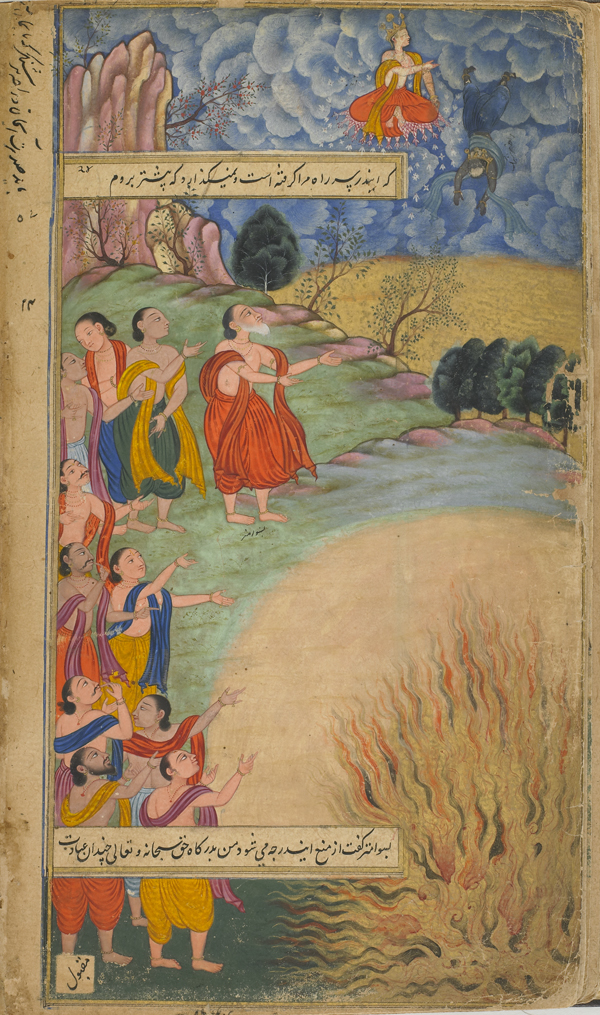
In an earlier post I had documented the existence of Razmnama, a Persian translation of the Mahabharata that was undertaken under Akbar's regime. This post is about 'Freer Ramayana' which, from what I have been able to gather, is an illustrated manuscript of the Indian epic Ramayana which was painted for a Moghul nobleman. There is no accurate information on who this nobleman was but the style of artwork it uses is quite similar to the ones found in Akbar's aforementioned work. So it could be that Akbar was the Moghul who had sanctioned this project too. Any further information on this would of course be appreciated.


Given below are some of the pages I could gather.  What is curious about it is the consistent usage of horns (as seen in depictions of Satan/Shaitaan) to depict evil characters in them while the Kings have the symbol headdress commonly seen in Islamic and Christian art. What is also interesting is the use of predominantly red and black to depict the evil characters in the epic while the heroes are shaded in human form.


Angada kills Devantaka

Angada kills Narantaka

Bharata sets out to find Rama

Dasharatha in Ayodhya

Dasharatha and sons return to Ayodhya

Hanuman and Ravana

Hanuman beheads Trisiras

Hanuman looking for Sanjeevani herb

Indra prevents Trishanku from entering heaven

Kumbhakarna getting up

Kumbhakarna in battle

Hanuman carries a mountain back 

Rama kills Maharaksha
 
Rama kills Viradha

Rama Lakshama Sita Hanuman

Rama leaves for heavens

Rama slays Shambuka

Rama slays Ravana

Rama with the Vanaras

Ravana abducts Sita

Ravana loots Kuvera

Rysasrunga travels to Ayodhya

Sugreeva in battle

Sugreeva attacks Kumbhakarna

Valmiki getting the tone of Ramayana from a dying bird

Garuda and Vsnu

Dasharatha being cremated

Shatrughna killing Lavanasura and conquering Mathura


Thursday, October 20, 2011 0 reflections

An alternate Ganesha


Preface
One of the most prominent symbols of Indian mythology and the major share holder in the Hindu pantheon of Gods is without a doubt Ganesha. Every year, millions across the world bow down in salutation to this much beloved and revered deity and ask him to forgive their sins and to bless them with health and success. If you were born in India then you probably know the story all too well. Introduced to you by an elder (usually the mother or grandmother) in infancy and then consistently reinforced throughout your teen and adult existence with such alarming frequency that some eventually reach what I call a state of 'religious coma'. This is that stage where your hands automatically go up in a temple when the aarti is done to the idol, when you mechanically extend your hands out when the teertha (holy water) is offered by the priest and you find it almost blasphemous to walk away without a piece of the flower that had been used in the pooja. While in Udupi a few months ago, I saw a singular evidence of such seasoned behavior when a fellow swallowed a piece of gopi chandana thinking it was a sweet prasadam. It was after the powedery lump had hit his taste buds that he inevitably swallowed it with much visible annoyance. This blog, hence, is an attempt to try and step past that state of coma and look deeper into the man behind the God.

So we look closer at Ganesha. We all know him as the son of Shiva and Parvati and the brother of Kartikeya. We also know that he is popularly called the vignanaashaka or remover of obstacles and is often used as the first point of reverence by many whenever a new venture or undertaking is initiated. Is there a bigger more recognized Indian deity for all intents and purposes? Unlikely. The buck certainly begins and stops at the mooshaka-vaahana Ganapati. The million shlokas out there form an impenetrable bulwark against the glory of this timeless icon.

The most popular version of how Ganesha ended up with an elephant's head is of course also common knowledge. If you are unaware of this somehow, then I can certainly guide you to the right starting point. But my pondering with this post isn't about what we've already heard. It is about the possibility of removing the mythical aspect from Ganesha's story and examining it with a more relevant pair of eyes in today's setting. Why? Because of two critical reasons: One, it throws open possibilities that might not seem as far fetched as accepting a story of an elephant's head being medically compatible with a (dead) human body. And two, it perhaps will engage us, force us even, to look at Ganesha outside this 'religious coma' I mentioned earlier, as a deity who definitely deserves our eternal devotion but for more humane reasons than divine.

So what am I talking about then? Well this – what if none of what we have heard actually happened when Ganesha was born? The whole beheading of a boy and then reviving him back to life by replacing his head with that of an elephant's head? What if, for the sake of focus, Parvati did actually give birth to a healthy baby boy who unfortunately was born with a huge facial disfigurement that made him look like someone with an elephant face? Perhaps an elongated nose that appeared like an elephant trunk? There are several cases reported every year all over the world of people with facial tumors and such being operated upon so this does not seem too unlikely if we discount the mythological aspect from it. The famous 'Elephant Man' being one of them and the recent instance of a Chinese man who was operated upon had a similar affliction. We can safely assume that such a potentially life threatening medical procedure was not around back then which is why there wasn't much anyone could do for the boy and hence was thereafter affectionately called gajamukha – the elephant faced one.

The most intelligent one

For this cruel infliction that nature had cast upon little Ganesha, it appears that it made it up in an extremely generous way. Ganesha wasn't just naturally brilliant but was also blessed with an amazing accuracy for detail. He is said to have been an immensely curious boy who had an inexhaustible appetite for learning. Given his physical limitations, it is possible that he spent all his awake time reading up every veda and upanishad ever written. This not only made him the most learned person in the universe but also an extremely wise one. This was conceivably a feat beyond compare since it automatically made him a symbol of learning and education. The men who wrote scriptures thereafter perhaps began using Ganesha as a source of much motivation every time a new venture would come by since what better way to energize oneself than thinking of a lad who, despite his physical limitations, had overcome every obstacle to keep himself intellectually hungry? This is perhaps why even today Ganesha remains a primary point of reverence amongst religious folks in India.

The most devoted son

There are various stories that highlight how devoted Ganesha was to his parents, especially his mother. The rationale behind this also doesn't seem too far if we consider how much love and pampering he had been showered with right from his birth. He had been kept on a very high diet of sweets (modak being his favorite) and other rich delicacies which not only made him gain weight but also slowed down his movements considerably. This is why that metaphorical story of him circling his parents when challenged to go around the world three times is often narrated. Maybe this indeed happened and maybe his brother Kartikeya did actually get on a bird and fly around the world. But given the impossibility of Ganesha of doing something similar, he chose to be the wise one and rightfully highlighted that his parents were his only world. Why would he do this unless he was absolutely convinced that no one loved him more than his parents? This story since has also become an ideal example for kids to learn that they should respect their parents.

The perfect scribe for Mahabharata

It is a well known fact that Veda Vyasa, the author of Mahabharata, used Ganesha to pen down the epic. Why would he do this unless he was certain of Ganesha's unmatched literary prowess? We can all agree that the epic was Vyasa's biggest project. Then why not choose someone who had gained some experience in that area earlier? Simple: because there was no one like Ganesha when it came to not only jotting down what was being said but also doing it with elegance beyond compare. This is perhaps why Ganesha had told Vyasa right at the beginning that he would write down the epic only if Vyasa narrated (or sang it) without a pause. Vyasa had then agreed to that after laying his own condition that Ganesha should 'understand' each phrase before jotting it down. Ganesha's intellect was so superior then, that Vyasa had to force himself to dish out such complex phrases that despite the speed at which Ganesha was processing and writing it down, he would need to pause and decipher the meaning before proceeding. These were the moments where an aged Vyasa would sit back to take a break. Hence, this arrangement was designed to get an aging Vyasa's work done by a young and curious Ganesha who loved reading and writing.

The ideal leader for the Ganas

Since we have already mentioned several times as to how big a source of inspiration he was to everyone around him, it is not impossible to think that the Ganas automatically looked up to him as their friend, philosopher and guide. Given his vast wisdom, it is possible that they would turn to him for all kinds of advice and directions to lead their lives in the best way possible. This is perhaps why, aptly so, he was labelled the 'eesha' for the 'ganas' – Gana-Eesha – Ganesha or Ganapati.

Iconic associations

a) The mouse at his feet
Ganesha is often portrayed as being seated with a mouse at his feet. There are many versions as to what this actually means. One of them appears in John Grimes' 'Ganapati – Song of the self' where he says that the mouse is representative of the various obstacles (or vighnas) that life presents us with. Ganesha, given his mastery at having overcome much hardship in life, is then definitely the right representative to look for if the biggest obstacle in life can become as small as that mouse in the Ganapati photographs and kneel down in front in meek surrender. Another version of this representation from Alice Getty's 'Monograph of the elephant faced God' is that despite being a glutton, Ganesha allows the mouse to go ahead and eat some of his laddoos and modaks because he was that generous. He never judged anyone based either on their caste or economic worth. He helped everyone who came his way with his wisdom and intelligence. This is why the mouse represents the needy and the helpless who can always turn to Ganesha for support.

b) Ganesha's wives – Buddhi, Siddhi and Riddhi
There are various interpretations as to whether or not Ganesha was married. Given the kind of child he is portrayed to have been, the only feminine associations he seems to have had was with his mother. He was most attached to her at such lengths that separating him from her was practically impossible. Given such a huge motherly attachment, it is unlikely that Ganesha was ever interested in any other woman. This earned him the status of Bramhacharya (state of strict celibacy). In the Ganesha purana, there is also mention of his being associated with buddhi (intellect), siddhi (spiritual power) and riddhi (prosperity) – all of which we can surmise were true given how intelligent,spiritually powerful and prosperous a life he had led thanks to extremely doting parents. So, in essence, he becomes a symbol of all three rolled into one thus making him a grand metaphor to look up to as a divine being. In the Shiva Purana, he is also said to have two 'sons' in Subha (auspiciousness) and Labha(profit). No surprises here either if we try to decode the meaning. If you are intellectually prosperous and spiritually adept, then every moment is auspicious and profitable thus translating to a consistent phase of contentment. Again, all metaphorically designed to keep us motivated from Ganesha's achievements.

c) Many hands/heads of Ganesha
This too is another popular interpretation where he is shown to have multiple hands (and sometimes multiple heads too). Just like Ravana, Ganesha too was gifted with such superlative intellect that it was as if he had multiple hands and heads. He could think as quickly as someone with four or five heads and write down stuff as swiftly as someone with four hands. Again, metaphorical interpretation only.

Inference

So what can we make of all this? Quite a bit. Even today we look up to people who have accomplished impossible seeming tasks despite their physical limitations purely because of a determined mind and call them heroes. If Ganesha also were to be looked at from an alternative angle then a similar source of much inspiration appears. Ganesha's story could be that of a sweet-mannered boy who was born with a horrible facial disability but just by his sheer determination went on to become one of the biggest icons of history. The fact that writers over the centuries have painstakingly ensured that only one popular version of his birth exists seems to indicate just how unprepared they must have been to tell a story where the son of Shiva and Parvati (both major divinities in India) did not have 'normal' features. And yes – if we want to believe that he was created by Parvati's 'essence' (some stories say sandal paste on her body, others say sweat or dirt) then that still holds true if she gave birth to him naturally. He is still a product of her being. So it is possible that authors made up the whole story of his head being cut off by Shiva since it not only lent itself to the mythical aspect but also contributed generously to the divine.

As with my earlier post on Hanuma, this post is not at all to undermine Ganesha's divinity in any way whatsoever. But it is to try and look at him from a human angle where he becomes a huge source of inspiration for all the projects we undertake and not a fictitious figurine from Hindu mythology who we pray to in a state of seasoned 'religious coma' and expect somehow success to come to us magically since I doubt it works that way. If Ganesha deserves our devotion it could be for the hurdles he overcame as a person, for his well mannered wit, his unmatchable intellect and his everlasting wisdom. These are the lessons I would take away and hence think of the man behind the God before my hands mechanically go up in salutation the next time I visit a Ganesha temple.


You might also like these posts in the Mythology section
Poem on last days of Dvarka
The Rama ~ Krsna Timeline
Looking for the real Hanuman
In search of Mayasura
Saturday, October 08, 2011 7 reflections

Looking for the real Hanuman

Preface

Everyone knows the most popular versions of Ramayana that have been high on our mythology diet in India. The whole feud between good versus evil and the thousands of back stories, sub plots, lessons of the moral kind and of course divinity. Yes – we've heard it all. But even as a child, one of the most fascinating characters from this epic I often found myself wondering about was Hanuma (or Hanuman). That brave and fiercely devoted vanara chief who spent most of his adult life passionately serving the exiled Kshatriya prince Rama. With time, Hanuma quickly became a symbol of strength, morality, friendship, devotion, honesty and even a representation of the Almighty. Almost every street in India has a temple honoring him. He even went on to become a huge media darling with everything from a full blown television series to children's animated features to advertisements being dished out under his name. For all intents and purposes, his image with Indian kids (and quite possibly a lot of adults too) is that of a gentle giant, a 'desi' Superman of sorts but without Lois Lane given his bachelor status. All of this we know.

But this piece isn't about the superhuman, the God incarnate, the divine entity in Hanuma. It is actually about that person, that individual, who for whatever karmic purposes was present in that channel of time to be immortalized as one of the many Gods the Hindu pantheon is always dizzy with.

So where do we begin? Let us imagine that if I were to get into a time machine and transport myself back into Tretayuga what would I see that isn't connected to any magic, any miracle, any well edited computer graphic generated spectacle? That is what this piece is all about. An attempt to smear the age old photograph of unbridled and mostly unquestioned devotion with the paint of some reasoning in an attempt to hence arrive at its by product – respect.

Starting Point

I began my research with trying to find out about what the word 'vanara' actually meant. From what I understand the vanaras were a group of forest dwellers (sort of like adivaasis) who lived in the then known region called Kishkindha (roughly present day Karnataka). On further examination I learned that given the description of their physical appearance, they were quite possibly at the final stage of evolution into complete humans. Hence the word 'ape-like humanoid' is used everywhere. What might this mean? Well, they weren't humans yet (conceivably because of their genetic coding being of a different nature, geographical reasons) but weren't mere apes either. They were, for the lack of a better word, ape-people. They could speak, gesture, reason and even emote like normal humans. Sort of like the euhominids (maybe a root word for humanoids?) They were very mischievous, quite aggressive, extremely curious, had a generous appetite for fruits and nuts and were physically well built with an extremely strong presence of mind.

With this image established I ventured further. Tracing Hanuma's birth wasn't too hard. His mother was Anjana and father was the tribal chief Kesari. There are various versions of Hanuma's birth and the most popular one (and the reason he is called 'son of the wind God' or Vaayuputra) was because Shiva's 'essence' began falling to earth during the great churning (Manthan) on seeing the bewitching damsel Mohini. The wind God, apparently, fearing some big catastrophe if Shiva's essence were to hit the ground captured it and later, when the time was right placed it in Anjana's womb. Thus making Hanuma an avatar (reincarnation) of Shiva. The other version is that Anjana and Kesari performed intense prayers to Shiva over a very long period of time and were granted Hanuma as a boon by a pleased Shiva. One more popular version is that when Dasharatha (Rama's father) was performing a grand Putrakarma yagna at Ayodhya to beget children, a part of the payasam (sweet pudding) from that prayer which was to be distributed among his three wives was accidentally picked up by the wind and put into Anjana's lap. She consumed it and Hanuma was born thus making him indirectly Rama's brother and hence also explaining the extreme regard he had for Rama.

All these versions lend themselves unarguably towards the inclusion of supernatural elements of boons, curses and other divine interventions. The simpler, most likelier, version could just be that given the exemplary nature of Hanuma's strength his comparison to both Shiva and Vayu could be nothing more than well placed metaphors. It could be that Hanuma had an absolutely natural birth from Anjana (Kesari being his biological father) but even as a child he was so unbelievably strong and different from other vanaras that the comparisons were inevitable. So basically it was Valmiki's way of peppering the story with ingredients that made for excellent reading.

Flight to Lanka episode

With this shaky backdrop I ventured further. The one incident that begs explanation was when Hanuma reportedly flew to Lanka to try and find out more about the abducted Seeta. In the Valmiki Ramayana there is an entire section dedicated to just how huge he grew in size, how the rocks and stones of the mountain he stood on began shivering and how he soared into the skies, tearing apart the clouds and surging forward amid the delirious cacophony from the other vanaras. On closer inspection it is revealed that he must have taken off from Dhanushkodi at the southern tip of the Indian peninsula and landed in Thalaimannar on the Lankan shores. The distance between the two is roughly about 27- 30 kms. When I zoomed in on this area on Google maps I noticed small islets peppered between these two spots. Now I know these images are from recent times and obviously the sea must have looked quite different 5000 or even 10000 years ago. But is it not possible that these islets were much bigger, more obvious back then and stood out pretty clearly along the sea's horizon? Given that global warming is now being proven as a real happening water levels were bound to rise across the planet and not surprisingly the islets were bound to submerge under water as we now see them. Hypothetically then, knowing Hanuma and the kind of ceaseless energy he is said to have had, is it not conceivable that he traveled from one such islet to another – sometimes jumping, swimming at other times, resting for a bit in places until eventually he managed to reach Lankan shores? It is not mentioned anywhere in Valmiki Ramayan that he took 'x' number of hours to reach Lanka. What is mentioned of course are the various mythical creatures he encountered on the way. Since we are on a mission to try and keep things as non-mythical as possible let us assume for the sake of an argument that these 'creatures' could have been wild animals or other aadivasi tribes in the area who might have lived on these remote islets? And since they understandably saw Hanuma, the vanara stranger, to be a threat they might have attacked him. He, being the strong and confident vanara chief that he was, took on their challenge and killed them without hesitation. This approach also might help in the story of Makaradhwaja who is known as Hanuman's son. The myth version of it is that a drop of Hanuman's sweat/seed fell into the sea which was consumed by a sea creature (perhaps now extinct) making it pregnant. The creature was then caught by Ahiravana's men and when its stomach was split open the part creature part vanara offspring was found who later went on to become one of the main guards for Ahiravana's fort. So was this episode an example of how a euhominid was somehow compatible with whatever species that sea creature was? Lot of interesting possibilities emerge.

So if this indeed were the case then why glorify this effort by Hanuma then? Simple – it was a way to honor his courage and strength in the face of something as unknown and potentially life threatening as going into the kingdom of the lord of three worlds Ravana. It also was a testament to his fiercely growing devotion to Rama in whom Hanuma had begun to see a reflection of the divine. Today we do extraordinary deeds for those we consider friends. Things we ourselves are surprised by when seen in hindsight. So it should be no surprise that Hanuma would have done something similar for someone who he believed was the true image of a good, just and ideal human being. Someone to look up to. Someone to worship selflessly his whole life. Someone worthy of being worshiped.

Flight to the Himalayas to save Lakshmana

The other incident that begs for some insight is when Meghnad, Ravana's son, injures Lakshmana badly in the war. Sushena, the medicine man in the vanara camp, advises that only the Sanjeevani herb (Selaginella bryopteris) can cure Lakshmana's wound. He also adds that the only place this can be found in is the Himalayas all the way in the northern part of the Indian peninsula. Now we can safely assume the war was taking place somewhere in/around northern Sri Lanka. Obviously the distance between there and the Himalayas cannot be covered in a matter of hours. Yet in Valmiki Ramayana Hanuma is said to have become a giant and soared through the skies to Himalaya and back. Also, because he couldn't figure out the right herb he is said to have broken off a chunk of the mountain he was on and brought the entire fragment back. An image that has plastered itself all over the nation for centuries now. Once the medicine had been administered he is said to have taken the mountain back as well. This whole episode takes only a few verses in the 'Yuddha Kanda' of Valmiki Ramayana. So how do we try to put a rationale here? I thought about this for a while and I have two theories of what could've possibly happened if we discount the flying factor.

Theory 1: Hanuma was a siddha. What that means is he was an individual who had gone beyond the 'aham-kara' stage (ego) and attained a higher level of yogic power. His control over the mind has been used in several contexts despite being a vanara who are often portrayed as unruly and easily distracted. In fact it was he who introduced the concept of Pranayama yoga to the world. So if we assume that Hanuma was a top level siddha then mind travel would not have been a very hard thing for him. In fact I am pretty sure that in the tribe that he was, there were very few vanaras (excluding Angad,Sushena, Nala and Neel who were the architects of the group among others) who were as mentally astute and precise as he was. So one possibility is that he used a flying creature (perhaps a variation of the Jatayu bird that could communicate in some form? Humans have always had a way to speak with animals and birds for eons so maybe Rama too knew this lingo and hence was able to get details of Sita's kidnapping?) and trained it to fly to Himalayan region. There is also the chance that the bird did actually bring back the medicine on time and without confusion. But it was still Hanuma's extreme mental prowess that helped in this Herculean process. Hence making the whole episode a grand metaphor for 'Hanuma bringing the medicine from the Himalayas'.

Theory 2: Fine, so there were no birds or such involved. That might still seem much in some ways. Let us examine this alternative then. Hanuma actually did go to the Himalayas himself and bring back the Sanjeevani. But how long did it take him? A week? A month? A year? We know he was a force to reckon with and so he definitely used his sense of direction to lead him. This also explains his alleged fight with the drunken asura kings in the middle of the jungle one night. In fact Valmiki Ramayan also states that it wasn't just Lakshmana who was injured. Rama went down too. Sushena, the great medicine vanara, used a concoction to revive Rama instantly but was unable to bring back Lakshmana. So is it possible that Sushena then went on to preserve Lakshmana in some state of coma as Hanuma took a week, maybe even a month or more, to return with the right medicine? Given Hanuma's unquestionable strength and will power (because he was a siddha) this does not seem impossible. Ravana was in no hurry to the end the war since it wasn't he who had initiated it. So we have no reason to believe he was in a rush to finish things off with Rama. So could there not have been a brief period's pause in the war as Lakshmana struggled for life? Even here Hanuma did actually bring back the medicine albeit not by supernatural skills but yes – via extraordinary mental and physical power – which is almost akin to something supernatural.

Other incidents of shape shifting etc.

There are many such incidents in the Ramayana that narrate Hanuma's ability to reduce and increase his body when needed. This includes incidents where his tail shrunk and grew at will for various events to take place. All of these, when seen without the glasses of mythology, do lend themselves to some sort of reasonable explanation. Being the highly accomplished siddha purusha that he was, using his mental prowess to hypnotize people, create an illusion, appear and disappear like a magician would not have been very hard for him. These incidents, given their complex nature, somehow might have made Valmiki to simply drown the pen in the magical paint of divinity and etch down what was not really false but wasn't a 100% accurate either. A middle path of sorts that oscillated between fact and fiction and to some extent simplified the whole thing.

Inference

The reasons for why Valmiki might have taken this route is pretty clear. Given the effect epics like Ramayana have had on the civilization cannot be undermined. It tells the tale of honor, of being good human beings, of respecting relationships, of loving your family – all ideal values for an ideal society. But the sad consequence has been the over glorification and tragic misinterpretation of these texts. Today we see people cut each other's throats in the name of Rama and Hanuma. They use these epics as a way to terrorize factions that don't agree with their point of view. My take simply would be to honor these epics for the human values they present and not the divine. Yes, Hanuma was an immensely passionate individual who saw the divine in his friend Rama. Who stood by him every step of the way even as Rama made questionable decisions about his wife even after she was rescued. So what? All of us have people in our lives we look up to and try to idolize don't we? Despite their shortcomings? Then why build a temple for Hanuma then? Simply put – to respect him for being committed to all his relationships. To recognize him as being that brave vanara chieftain who weathered good bad and ugly in a bid to win what he was convinced was the war against evil. To symbolize his existence as not just an extremely fit forest dweller who accidentally happened to be connected to one of the biggest epics ever told but for his role as a devoted son, brother, leader and friend.

I do not know how much of all this really happened and quite honestly at the end of the day I don't even think it matters. This blog was an effort to try and explore the human side of a deity who millions worship across the world but may not fully understand why. If in this process I have encouraged you to see a side to Hanuma that goes beyond the glossy high definition color photographs sold in the market for a dime then I shall consider my attempt a worthy one.


Other recommended reading:
In search of Mayasura


Other sources - 3D sketch of Hanuman used from CGTantra.com


Sunday, October 02, 2011 9 reflections

In search of Mayasura

For the last few days I have been spending a lot of time researching stuff about Indian mythology. The trigger for this sequence began when I accidentally found out that there was a temple for Pandavas (and Draupadi) in the heart of Bengaluru! This then led me to continue tunneling through the millions of pages sitting unexplored over the web and fishing out choice pieces that gave me a new/alternative/contradictory view of the traditional 'it must be true because elders/scriptures say so' rendition of the epics like Mahabharata and Ramayana. The idea behind this exercise wasn't so much to try and say 'here, this is *the* correct version of such and such a story'. It was more an attempt really to investigate some rationale, some practical purpose, some realistic (preferably non-mythical) explanation for the events that we are always treated to with a spicy dash of magic and fantasy.

So, what have I found out thus far? Well not a lot but a few things that I hadn't known before. I have started bookmarking my findings under the 'Favorites' tab of my Twitter handle. Those who are interested in looking them up can do so by visiting the URL below:

http://twitter.com/#!/shakwrites/favorites

Now, with that little intro and shameless marketing bit done, let me zero in on the theme of this blog. 
And also, before I begin, I have marked the sources for this blog as numbers from 1 to 5. You can find the actual links for these web pages at the end of this blog.

I stumbled upon a paper titled - 'The astronomical link between India and the Mayans' [1]. The piece – possibly a student paper for some project – discusses the possibility that there was a link between the Indus Valley civilization and the Mayans. The author provides some interesting (albeit debatable purely from a time line/historic point of view) instances of Vedic warriors (possibly Arjuna) making a trip to the Mayan lands. It goes on to suggest that a friendly alliance between Arjuna and Mayasura (Ravana's father-in-law and Mandodari's father. The great mythical engineer, architect, magician from Vedic times) had been forged. Now, we know that Mayasura was indeed a master builder since he is the one mentioned in the Mahabharata during the burning of the Khandava forest incident where he helps the Pandavas by building the fabulous mayasabha. He is also prime in the puranas during the creation of the mythical city of Tripura later destroyed by Shiva. [2]

So what about Mayasura then? Well this. I stepped upon this one blog [3] where the author mentions that Ravana and Mayasura had a falling out. Now, I am not sure if this is connected to Surpanaka's husband Asura Dushtabuddhi or not. I am still checking my sources on this. But nevertheless it is mentioned that on being exiled by Ravana after a huge spat, Mayasura used the netherworld route (pataala loka - which has been mentioned thousands of times in various contexts in the texts) and headed to the core of the earth. We know that Ravana's brother Ahiravana (or Mahiravana depending on the text you read) was the lord of the underworld. If we were to assume that Mayasura continued his journey onwards from Ahiravana's empire, and since the globe is round, the only place he could 'exit' back on earth was Central America. Presuming we are talking about a time line 4000 – 5000 years old here, that area might have been just jungles since as far as we know the human existence in the Mayan civilization dates back to only about 2000 BC. But then again the concept of time was different back then so there is obviously a very good chance there is room for critical errors here.

Now, be that as it may, this possibility triggered a thought in me. Geographically speaking, the direct route that connects the Indian peninsula and Central America does make sense in the current context. As the author suggests, take a globe and pierce a hole where India is. The needle will reappear where Mexico/Central America is. But was this what the world looked like 5000 years ago? Were the continents separated at more or less the same distance back then too? Or did Mayasura end up, if at all he did use that route, somewhere else? If so, then where? Worse yet, did he even take that route at all?

This is where a fellow tweep @Zenia_Dstranger's comment caught my attention. On reading the piece posted in [1], she said that Mayans had not been discovered by the rest of the world until the Spanish invasion began taking place in early 16th century. If we consider that is true, then there should be absolutely no major similarities between the Indus Valley culture (or the Hindu culture, for all intents and purposes) and the Mayans since not only are we speaking of huge geographical differences, but also culturally there should be no reason to believe they had anything in common. But that is where I ran into more questions and began researching the similarities between Mayans and the Indus Valley people. During this, I ran into two well articulated pieces - 'Mayan periods and Vedic architecture' by Marcus Shcmieke from the European Academy of Vedic Sciences [4] and a blog piece by a blogger named Mahesh who uses sources from several published works and journals to list a lot of similarities between the two customs [5].

Both of them discuss some amazing architectural, cultural, linguistic and lifestyle based similarities between the two civilizations which are not only surprising but also thought provoking. There is no denying that a lot of this does make sense in a general context but there is plenty still left for debate. For instance, the time line issue. The discrepancy of almost 1500 years between the historic findings in Mayan regions and the connections made to Mayasura. There is also the issue of origins. If indeed Mayasura was the creator of the Mayan regions then where did those people come from? Were they already there when he went there? And then he made his own 'world' using resources from his routes in the Indian peninsula to exchange science, language and technology? Or were they 'created' through some divine intervention as part of Maya's large scheme of things? If neither of this actually happened then why is there so much similarity between the two huge civilizations in some of the factors underlined in those articles? Having lived in South America for 7 years and traveled extensively in that region (including Guatemala) the observation I made was how similar the Latinos and Indians look. Could this also be a clue to indicate that link from thousands of years ago? Or is this all just a giant piece of disconnected items that just do not mesh?

Unable to keep these questions to myself, I have presented to you my infancy stage findings thus far in this quest. There is good chance I am reading the right stuff. There is also the chance that this search ends here and will take me no further. Whichever route I take, I did want to unburden myself with this data before it left me.

Now, reader, I ask of you just this. If you have read, seen or written something which is similar to the contents of this blog, please feel free to leave a comment below with your thoughts. Who knows, maybe together we can put this riddle into place or maybe we conclude this wasn't a riddle at all to begin with. Either way, this scratching the surface attempt would have been worth it.

Cheers,


Sources

[1] http://tinyurl.com/6cwpcuz

[2] http://tinyurl.com/6395ehh / Also read this 'Math and Myth' piece on Tripura: http://t.co/hSPz1Tm

[3] http://tinyurl.com/64psqex

[4] http://www.veda-academy.com/articles/vasati/mayas_pyramids.htm

[5] http://indiamahesh.wordpress.com/2010/05/26/pre-columbian-american-indian-connection/

Saturday, September 12, 2009 0 reflections

Welcome to Paley Ramayanam!


What does the late American jazz great Annette Hanshaw have to do with one of India’s premiere mythological pillar – Ramayana? The answer to this question is the animated feature I came across called ‘Sita sings the Blues’ by American artist/cartoonist/animator Nina Paley. Had it not been for my curiosity to read a little more about King Ravana just to ensure I knew more than my wife about him, I would have never come across this masterpiece of a creation. So in a way I’d like to thank my love for being that subtle cause. Smiles.

‘Sita sings the Blues’ is an independent animated movie that re-tells the Ramayana using mainly 2D animation and some immensely refreshing screenplay. The premise unfolds in three parallel tracks – one, with an American couple living in San Francisco with the husband getting a project in Trivandrum in India; two, three Indians (yes yes, actual Indians!) voicing three shadow like caricatures bickering and debating about the events that Ramayana is popular for and a third, sort of, platonic/musical track is the animation piece where Sita breaks into one of Hanshaw’s classics every time a relevant situation presents itself. Like ‘Daddy wont you please come home’ when she is abducted by Ravana or ‘Who’s that knockin’ when Rama arrives at Ravana’s door with his 'vaanar-sena' to rescue her. The moments and the way these songs lend themselves to the scenes are absolutely brilliant.

What also becomes obvious is how unassuming and non-philosophical the whole thing is. Even the dialog between the caricatures in Ramayana is so simple and regular, that one can’t help but giggle when the evil Kaikeyi says to Rama on his banishment – ‘Don’t let the door hit your ass on the way out!’ Is that not what she really would have felt like saying anyway? This is seriously funny stuff.

What also gets your attention quickly is the absolutely gorgeous artwork. Be it the drawings that are set to a very ‘Rajasthan painting’ like motif or the 2D animated waist wiggle that Sita gets into whenever she thinks of her beloved Rama and voices out classics from Hanshaw’s collection. There is also one brilliant piece just after intermission (and may I add, that was the best intermission I have ever seen in an animated piece!) by Todd Michaelsen called ‘Sita’s Fire’ are plain awesome. The way these various types of art pieces blend into one another with such finesse without taking away from the main plot is an effort that can only be described as – genius.

But then ‘Sita sings the Blues’ is more than just eye catchy drawings, a narrative that holds you in place and a much contemporary way to retell the epic with the most unlikely Jazz legend for the songs! It is about demystifying the way Ramayana has been told for so many centuries in our country. We have Rama as a brave warrior who, despite being a just King and a righteous man, falls short of being the perfect husband and father. In ‘Sita sings…’ not only is he portrayed as extremely human and intensely flawed, but even the ‘God’ factor is finally skinned out which, I thought, was such a refreshing thing to do. For so many decades there have been murders, riots, rapes and looting in India using Rama’s name as the only rationale. It was definitely about time someone gave that a bottom line and presented a much more mature, albeit said in a kindergarten level intellectual sequence, and realistic way to see and use the teachings from this epic. Something that actually helps the American woman in the parallel story track to do once she gets her hands on the Ramayana. What also makes you reflect on your own knowledge of the story is how Ravana, the villain of the piece, is hinted at being the actual good guy in the story! A thought that had never occurred to me. Sure, he abducted Sita against her will but hey, was that not all he had done to wrong Rama? He didn’t touch her person. He didn’t force himself on her in Lanka. Heck, he didn’t even make Herculean attempts to find Rama and finish him off. A thought that throws more light on Ravana’s much ignored and definitely much clichéd personality in our modern history.

I strongly urge everyone to see this beautiful masterpiece of a movie not just to appreciate the artistic value it so boldly embodies but to also understand the subtleties with which it tells us how to get our priorities straight without being preachy.

The only 'drawback', if I really had to pick, would be the slightly feminist seeming climax. Maybe it is just me but again, maybe it was a tongue in cheek ploy at looking at how Hindu mythologies have always worked. I am unsure. But somehow I felt it could have been choreographed in a less assertive manner.

Nevertheless, this now is officially in my ‘all time favorites’ list!


Rating:


Download the DVD for free here! Or watch it on YouTube!


;